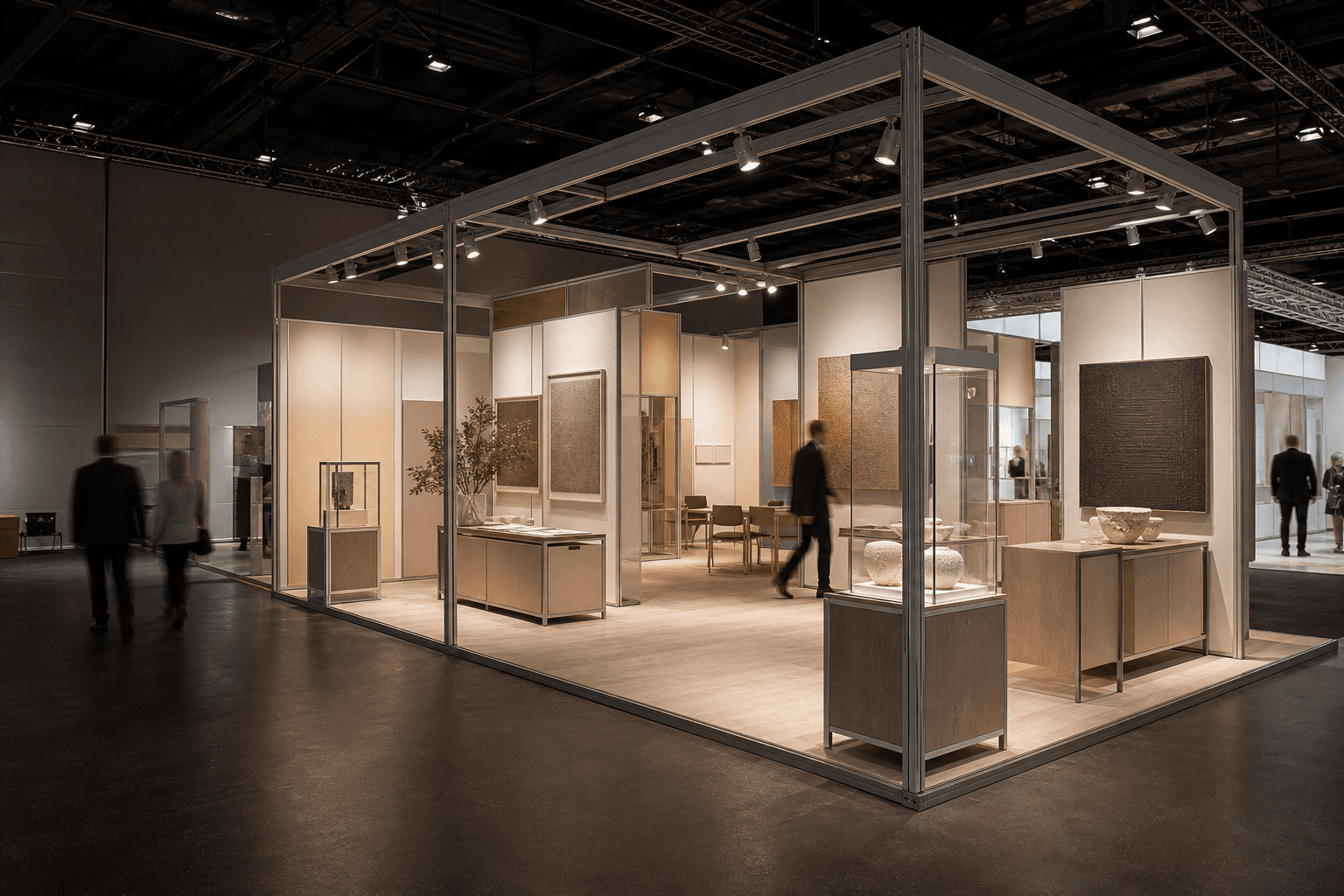
The most expensive item in a temporary exhibition is not material but repetition: the display cases, panels and hanging systems produced from scratch for every new show. A modular display infrastructure cuts installation time, budget and storage burden at once. We set out how such an infrastructure is built, where it saves money and where it turns into a trap.
What separates a permanent exhibition from a temporary one is not duration but the number of repetitions. A permanent exhibition is installed once and lives for years; a temporary exhibition is rebuilt from scratch several times a year in the same space, in front of the same walls. That difference changes the criterion of the design entirely: the question is no longer "how good does this exhibition look" but "will this arrangement still hold up the fourth time it is installed".
In practice most institutions never ask that question. New display cases are commissioned for every exhibition, new holes are drilled into the walls, graphics are pasted onto the walls again, and when the show closes it all ends up in a skip. After three exhibitions the picture is this: a significant part of the money spent went not into the work on display but into doing the same job over and over again.
In this article we treat temporary exhibitions and trade fair stands as an infrastructure problem: how a modular display system is built, what it earns you, and at what point it collapses under its own weight.
1. The real constraint on a temporary exhibition is the calendar
On a permanent project the hardest constraints are usually budget and space. On a temporary exhibition the constraint is time, and it is not open to negotiation. An exhibition hall hosts more than one show in a year, and the window between two of them is usually somewhere between a few days and a few weeks. All of the following has to fit inside that window: dismantling the previous exhibition, wall and floor repairs, the new installation, lighting adjustment, graphic application and a rehearsal before opening.
At a trade fair the window is far harsher. The build is usually compressed into one or two days and the breakdown into a few hours; and all of it happens inside the chaos of hundreds of stands going up at the same time. The venue's own build regulations, the crane and forklift queues and the scheduled electrical connection times all come into play.
This has a single practical consequence for the design: every detail that requires fabrication on site is a schedule risk. Every detail produced in the workshop and merely assembled on site is insurance. A good temporary exhibition design sends components to be assembled to site, not work to be done. Cutting, painting, finishing and fixing holes are finished in the workshop; on site only positioning, alignment and light adjustment remain.
2. Do not confuse the three layers
The essence of a modular display system is in fact a simple distinction. Everything in an exhibition space belongs to one of three layers, and the lifespans of those layers differ enormously:
Fixed infrastructure (building lifespan). The load capacity of the walls, electrical distribution and socket positions, the lighting track in the ceiling, the floor load limit, data infrastructure, climate control. These are installed once, correctly, and afterwards are almost never touched.
Semi-permanent equipment (years). Track hanging systems, movable panels, standard display case modules, the family of modular plinths and podiums. In every exhibition they are repositioned but never reproduced. This layer is essentially what people mean by a modular system.
Exhibition-specific layer (a single show). The layout decision, the graphics, label content, colour, and where necessary a purpose-made mount for one particular object. It is normal for this layer to be one-off, and that is not a problem.
The most common and most expensive mistake is letting something that belongs to the third layer bleed into the second, or even the first. Painting graphics straight onto the wall, fixing an exhibition-specific display case to the wall, installing the lighting to suit that one show's layout — each of these creates work that will have to be undone and redone for the next exhibition.
3. The four components of modular equipment
Track hanging system. A continuous track above the wall, steel cables or rods suspended from it, and hooks on those cables whose height can be adjusted freely. What this system gains you is not aesthetics but protection of the wall. An institution that drills into the wall for every exhibition is in fact buying a hidden plaster–filler–sanding–paint job every single time; that job falls at the tightest point in the schedule, immediately before the build, and it is almost always late. With a track system the wall is never touched, the weight sits on the track, and heights change in seconds.
Movable panels. Dividing panels on castors or running on a ceiling track, usable on both faces. They do two jobs at once: dividing the space to suit the exhibition and increasing the surface area available for hanging. The panel surface is deliberately the sacrificial layer — when it wears out over the years the structural frame stays and only the surface is renewed.
Standard display case modules. The key word here is "standard". Two or three types of case (table case, tower case, wall case), all with the same glass specification, the same locking system, the same base dimension and the same cable route. Because they share dimensions they can be arranged side by side, in a row or apart; a different composition is built for every exhibition, yet not a single case is remade. It also means one type of lock, one type of key and one maintenance procedure.
A family of modular plinths and podiums. A coordinated family of heights (three steps, for instance: low, medium and high), the same cross-section, and a surface that can be repainted. Placed side by side the plinths become a larger platform; standing alone, a single podium. In institutions with a wide variety of objects on display, this is the component that earns its keep the most.
4. The economics of reuse: how to run the numbers
It has to be accepted from the outset that modular infrastructure is more expensive than one-off fabrication for the first exhibition. A standard family of display cases demands more engineering, tighter tolerances and better materials than a single case made for the needs of one show. The decision therefore cannot be taken by looking at the budget of the first exhibition.
The correct calculation compares two totals:
On one side the one-off route: the fabrication cost repeated for every exhibition, multiplied by the number of exhibitions planned; plus the wall repairs, painting and electrical work repeated each time; plus the delay risk this work creates in the schedule.
On the other side the modular route: a one-time infrastructure investment; plus, per exhibition, only the cost of layout, graphics and assembly; plus the annual burden of storage.
In practice these two curves cross somewhere around the third exhibition, and every show after that is a net gain. But the real gain is usually not in money but in predictability: knowing the installation time up front, a schedule without surprises, and an exhibition team able to put its energy into content instead of chasing fabrication.
The trap here works in exactly the opposite direction: over-modularity. A system that tries to cover every eventuality turns into equipment that fits no exhibition properly, is complicated to install and costs more than it should. The healthy ratio leaves the bulk of the infrastructure modular and the remainder exhibition-specific. And it is that small bespoke part that gives the exhibition its character anyway.
5. Storage, transport and assembly: the invisible cost
The most neglected side of a modular system is where it sits when it is not in use. Forty panels, twelve display cases and a family of plinths have to wait somewhere when they are not in the exhibition hall. Modular systems set up without accounting for storage space end up scattered across corridors and plant rooms within a few years; there they get damaged and stop being a system.
For that reason the dimensional decisions are driven by logistics before aesthetics. Panel height and width are set by the door they must pass through and, if one is to be used, the lift. Module weight is kept below the limit two people can carry safely. Display cases and plinths are designed so that they can be stacked or stood vertically side by side. Wheeled transport trolleys are planned as part of the system from the start, not added later.
On a trade fair stand the same issue appears in the form of the flight case: the case is part of the design. Its external dimensions determine the freight cost directly, and a well-designed case does a second job during the build, as a counter or a podium.
In assembly the aim is to use as few tools on site as possible: push-fit or cam-lock joints, connections that can be tightened by hand, plug-and-socket solutions for cabling. Every module is numbered and the assembly sequence is set out in a manual. This makes it possible for any crew on site to carry out the build, not only the team that designed the system. That detail is decisive in environments such as trade fairs, where crews change.
6. Graphics and text: the layer that changes most often should change most easily
The thing that changes most often in an exhibition is the graphics; section titles, wall texts and object labels are produced from scratch every time. Despite that, the graphics are also the layer most often buried: titles painted straight onto the wall, large prints pasted to the wall, boards screwed to the panel. Every one of them damages the surface as it comes off and leaves a paint job behind it.
The right approach is to give the graphics a carrier. Boards that slide into a channelled profile, magnetic surfaces, tension fabric frames or lightweight boards hung from the hanging system — what they all share is that the graphic is fixed to an intermediate element rather than to the structure. Tension fabric systems are particularly strong at trade fairs: they are light, they fold, they take up little space in freight, and when the print is renewed the frame stays the same.
The same logic applies to labels. A standard label holder with a replaceable card inside it means only the cards have to be printed for each exhibition. For multilingual presentation, moving the content off print and onto digital — leaving only a QR code in the space — means no print has to be renewed when a translation changes. We covered the permanent side of display equipment and the subject of object conservation in detail on our Ankara exhibition space design page.
7. The shared infrastructure of trade fair stands and exhibitions
A trade fair stand and a temporary exhibition look at first like different jobs, and their aims genuinely are different: the measure of a trade fair stand is contact, the measure of an exhibition is understanding. A trade fair stand lives for three to five days and competes with the noise of the hundreds of stands beside it; an exhibition stays open for weeks, even months, and needs quiet.
At the level of infrastructure, however, the two solve almost the same problem: a narrow build window, a reusable carrier system, replaceable graphics, cased transport and tool-free assembly. That is why, for organisations that both exhibit at trade fairs and build exhibitions or brand experience spaces, the most efficient decision is to establish a single family of modules that serves both: the same structural frame, the same graphic frame, the same lighting track, the same case standard.
For our trade fair stand services by city you can look at our Ankara trade fair stand design, Istanbul trade fair stand design and Izmir trade fair stand design pages. Where permanent retail display is concerned the subject moves into showroom design; we set out the particular rules of shop and showroom display in our article on shop and showroom interior architecture.
Five common mistakes
1. Mistaking modularity for being able to take something apart. The fact that something can be dismantled does not make it modular. Modularity means that the parts belong to a shared family of dimensions and can stand in for one another. Ten display cases that can be dismantled but are each a different size are not a modular system; they are ten separate cases.
2. Leaving storage out of the calculation. A modular system with no answer to where it will be kept falls apart within two years and becomes unusable.
3. Burying the graphics in the structure. Every graphic painted or pasted onto a wall quietly adds a paint job to the next exhibition's schedule.
4. Installing the lighting for one exhibition. If there is no continuous track in the ceiling, every new layout generates new electrical work. The track is installed once; the fittings move an infinite number of times.
5. Taking the decision on the first exhibition's budget. Modular infrastructure costs more for the first show, and that is normal. The comparison should be made not against a single exhibition but against the total of all the exhibitions planned.
Frequently Asked Questions
How many exhibitions does it take for a modular display system to pay for itself?
Giving an exact number would be misleading; it depends on the number of exhibitions per year, the size of the hall and the variety of objects displayed. In practice the two routes level out in cost somewhere around the third exhibition, and after that the modular route pulls ahead. For institutions running more than one exhibition a year the decision is usually clear; for a venue that mounts a show every two or three years, hiring may be more sensible.
Does a small gallery need modular infrastructure?
Not all of it, but one component pays for itself at almost any scale: the track hanging system. In small galleries the real burden is wall repair, and the track ends that cycle on its own. A family of display cases and panels only becomes worthwhile once the exhibition programme intensifies.
Can the same system be used both on a trade fair stand and in an exhibition?
At the level of infrastructure, largely yes: the structural frame, the graphic frame, the lighting track and the flight cases can be set up in common. The narrative and the layout, however, are designed separately, because at a trade fair the aim is to attract attention and make contact, while in an exhibition it is to be understood.
How long does it take to install a temporary exhibition?
If a modular infrastructure is in place, the build is usually measured in days, and most of that time goes on layout and lighting adjustment. If everything is fabricated from scratch for each show, the time stretches into weeks and the risk of delay rises markedly. What makes the difference is not the material but how much of the work was finished in the workshop.
Can display equipment be hired, or does it have to be bought?
For institutions that exhibit rarely, hiring is a reasonable starting point. But hired equipment comes in standard sizes and may not fit the space properly; it also carries no brand identity. Once the exhibition programme becomes regular, building your own family of modules pulls ahead on both cost and identity.
Let us talk about your exhibition or trade fair project
At Kaya + Partners we design not just a single installation for exhibition and trade fair projects but the reusable infrastructure behind it: defining the family of modules, workshop fabrication, casing, the assembly manual and site management. For cultural and corporate display you can take a look at our Ankara exhibition space design page.
To discuss your project, get in touch with us; you can review our completed work on our projects page.