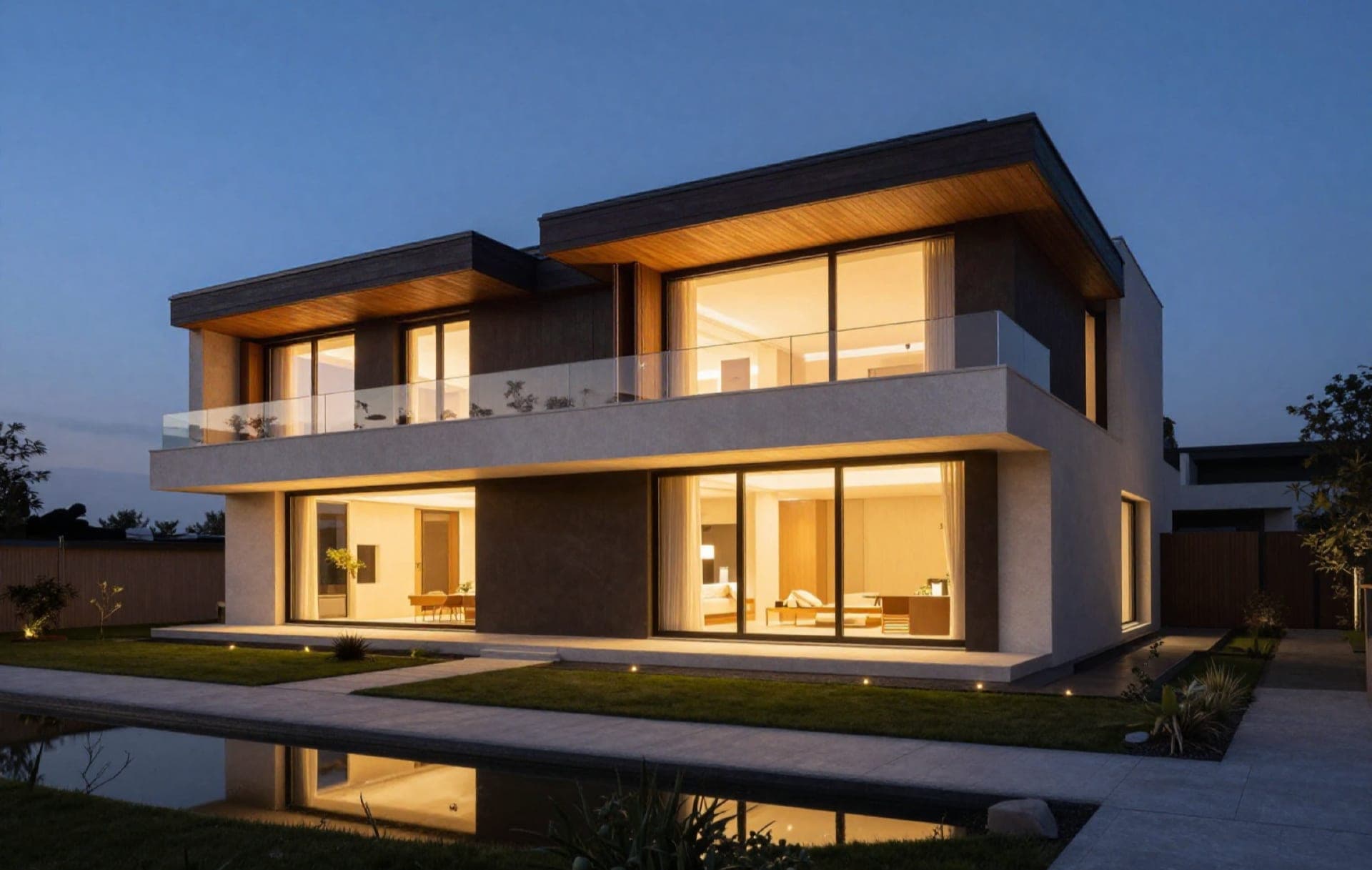
In smart home systems the most expensive mistake is not the choice of device but deciding late. We walk through what is still possible at each stage of a villa project, which decisions cannot be reversed, and what cost actually depends on.
When smart home systems are discussed, devices always take centre stage: which brand of switch, which sensor, which app. Yet in a villa the outcome is not determined by the choice of device. What determines it is at which stage the decision is made.
We see it on site like this: of two systems built with the same budget and the same products, one runs for years without trouble while the other becomes unusable within six months. The difference is almost always timing. In this article we set out what remains possible at each stage of a villa project, what cannot be reversed, and what cost actually depends on.
Stage 1 — Plot and schematic design: when the decision is cheapest
This is the correct moment to decide on automation, and most people miss it. At schematic design nothing has been built yet; everything is therefore possible and none of it carries an additional cost. Three decisions made at this stage determine everything that follows:
- The position and size of the low-voltage panel. This panel is the heart of the system. Its position cannot be changed later; if undersized it cannot be enlarged. Ventilation and service access must be resolved at the same time.
- Riser and route planning. How many data lines run to each room, which feeds go outside, where floor transitions occur.
- Reserving ceiling void. Motorised curtains and shading need a pocket void and a feed in the ceiling. If the soffit level is set without accounting for it, the option of motorised curtains closes entirely.
The cost of decisions made at this stage is practically zero — drawing a line costs nothing. Making the same decision two years later means opening walls, repainting and lifting floors.
Stage 2 — Shell stage: the last real opportunity
Walls are going up, services are being run, plaster has not started. For smart home systems this is the last stage at which infrastructure can physically be placed. The work done here is invisible but it makes everything afterwards possible.
The three omissions we see most often at this stage are:
- An undersized panel. A panel chosen for today's needs will not take a single module added three years later. Planning it at roughly twice the current requirement is far cheaper than replacing it.
- A forgotten exterior line. Garden lighting, cameras, irrigation valves, garden power and any pool equipment — their feed and data lines must be pulled before landscaping. Digging the garden up later means both cost and a ruined landscape.
- No spare conduit. This is the cheapest and most useful item on the whole list. An empty conduit route lets you pull new cable without opening walls when technology changes in five years. It costs very little; its absence means a major refurbishment later.
At this stage the infrastructure must be resolved together with the architectural project. We set out our approach in detail on the smart villa architecture page.
Stage 3 — Fit-out: devices and scenarios
Plaster is done, painting is starting. The infrastructure can no longer be changed, but what is built on it is still open. The real work of this stage is not choosing devices but defining scenarios.
Badly configured systems share one trait: everything can be controlled separately but nothing works together. The user has to open fifteen separate apps and adjust each one. That is more tiring than having no automation at all, and it is the number one reason systems are abandoned within six months.
The right approach is to start with a scenario list rather than a device list:
- Morning: blinds open in stages, heating rises to target, the coffee machine runs.
- Leaving: all lights go off, climate steps back, security arms, risky sockets such as the iron are cut.
- Evening return: entrance lighting greets you, the living area reaches target temperature.
- Film: light dims, blinds close, the audio system comes on.
- Night: exterior lighting drops, only wayfinding light remains inside, security activates.
- Extended absence: climate moves to minimum protection, irrigation follows the weather, lighting produces an occupied-looking scenario.
One rule: the app should be the last resort. Primary control must be the switch on the wall, and a guest visiting for the first time must be able to use it. A house where anyone without a phone cannot turn on a light is not smart but troublesome.
Stage 4 — A finished villa: the scope narrows but is not zero
If the villa is complete, the infrastructure decisions are behind you, but not everything is over. Lighting, climate and security can largely be automated with wireless solutions. The areas that stay limited are motorised shading, central climate control and comprehensive exterior automation — these depend on existing infrastructure.
In existing villas the right path starts with a site survey: where cable already runs, whether ceiling void remains, whether there is space in the panel. Quotes given without that survey either turn out too optimistic or shrink in scope during delivery. In stone buildings the work is more particular still; we describe how we handle it on the Bodrum smart villa design page.
What does cost actually depend on?
There is no single answer to smart home cost, because cost depends not on device count but on three things:
- The decision stage. Infrastructure planned in shell stage is a relatively small line in a villa budget. Adding the same scope to a finished villa brings secondary costs — opening walls, repainting, renewing floors — alongside the direct cost.
- Protocol choice. Wired systems such as KNX demand more effort at installation but are long-lived and vendor-independent. Wireless systems install quickly and cheaply but depend on batteries, range and manufacturer support. For most villas the right answer is hybrid: a wired critical backbone with wireless flexible endpoints.
- Scope. Lighting and climate only, or shading, security, audio, pool and energy management as well? The scope decision affects the budget far more than the brand of device.
The last subject not to skip: handover
This is never discussed in most projects yet causes the most trouble five years on. If the company that installed your system leaves the market, or you sell the villa, who will manage the system?
The answer must be settled at contract stage. At handover you should receive the system schematic, device list, all passwords and the configuration file. As long as you hold these documents another team can take the system over. An installation that does not hand them over ties you permanently to a single company, however good it is technically.
In summary
The right order in smart home systems is this: first define how you live, then produce the scenarios, then embed the infrastructure into the architectural project, and choose devices last. Most projects walk this order backwards, and so end up either expensive or unused.
Whatever stage your villa project is at — plot, schematic design, shell or finished building — we can report clearly what is still possible for the infrastructure. Get in touch or read the page for your city: Ankara, Istanbul, Izmir, Antalya.
Frequently Asked Questions
When should a smart home system be planned in a villa?
The right moment to decide on a smart home system is the plot and schematic design stage: nothing has been built yet, so everything is possible and the cost of decisions is practically zero. The position and size of the low-voltage panel, riser and route planning, and the ceiling void reserve are set at this stage. The shell stage is the last point at which infrastructure can physically be placed.
Why do smart home systems fall out of use so quickly?
The number one reason smart home systems are abandoned within six months is that everything can be controlled separately but nothing works together. The user has to open fifteen separate apps and adjust each one, which is more tiring than having no automation at all. To avoid this, start with a list of scenarios such as morning, leaving or night rather than a device list, and make the switch on the wall the primary control.
Can a smart home system be installed in a finished villa?
Yes; even in a completed villa, lighting, climate and security can largely be automated with wireless solutions. Motorised shading, central climate control and comprehensive exterior automation remain limited, because they depend on existing infrastructure. The right path starts with a site survey: where cable already runs, whether ceiling void remains, whether there is space in the panel. Quotes given without that survey either turn out too optimistic or shrink in scope during delivery.
What determines the cost of a smart home system?
Smart home cost depends not on device count but on three things: the decision stage, protocol choice and scope. Infrastructure planned in shell stage is a relatively small line in a villa budget; adding the same scope to a finished villa also brings the cost of opening walls, repainting and renewing floors. Wired systems such as KNX demand more effort at installation but are long-lived, while wireless systems install quickly and cheaply. The scope decision affects the budget far more than the brand of device.
What documents should you receive when a smart home system is handed over?
At handover you should receive the system schematic, device list, all passwords and the configuration file. As long as you hold these documents, another team can take the system over, even if the company that installed it leaves the market or you sell the villa. An installation that does not hand them over ties you permanently to a single company, however good it is technically, so this must be settled at contract stage.