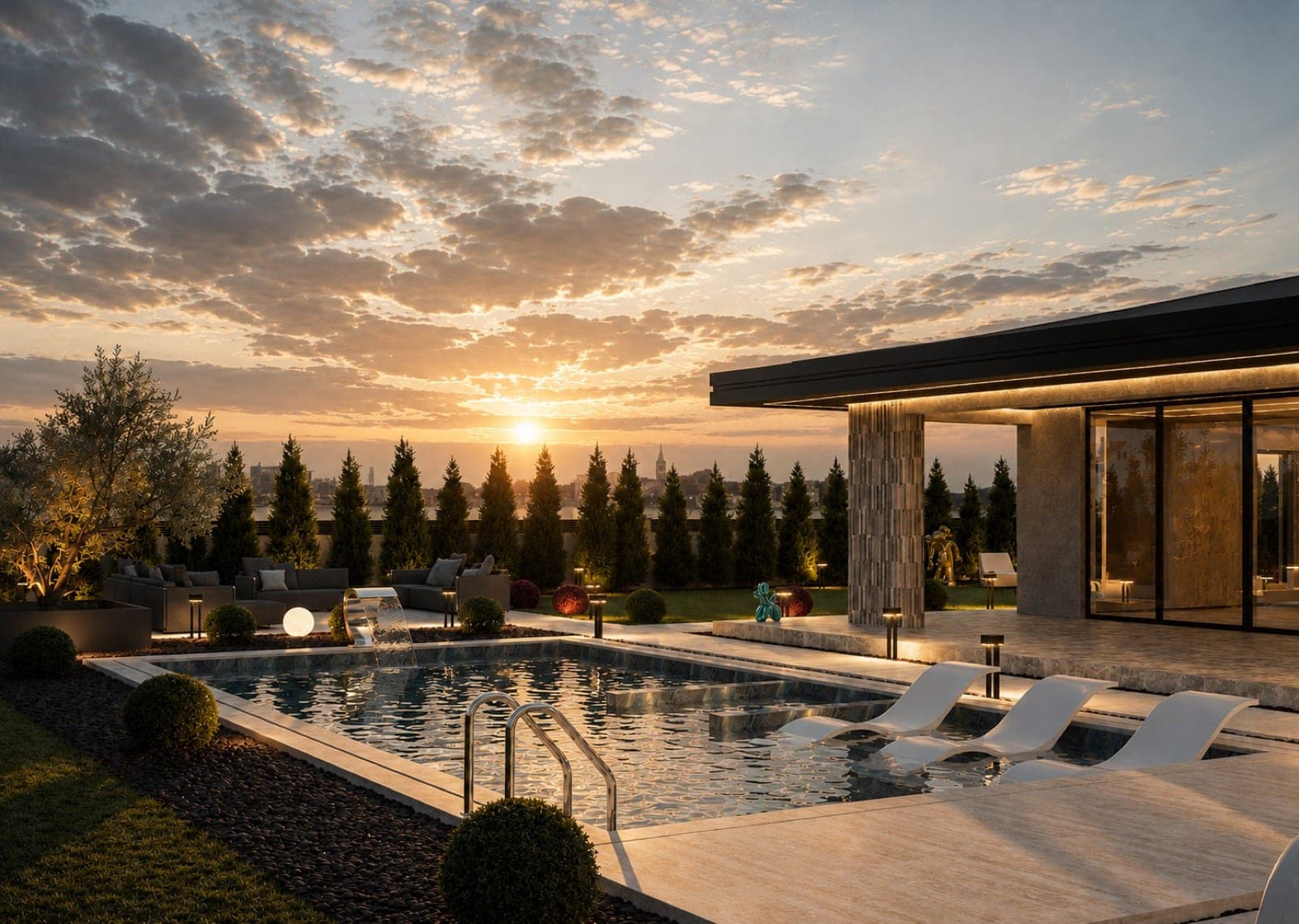
Most villa gardens look good but get little use: there is lawn, there is a pool, there is a seating group — yet nothing ties them together. Through the Opia Residences landscape project, we examine the seven decisions that turn a garden from a view you look at into a room you live in.
The situation we meet most often in villa gardens is this: the garden is beautiful but unused. There is a wide plane of lawn, a seating group at the edge, and a pool; each is right on its own, yet no relationship has been established between them. The result is a view — something looked at through glass rather than stepped into.
A well-composed landscape takes the garden out of the realm of spectacle and turns it into a room of the house. The route to that is not more planting or a bigger pool; it is establishing the relationship between circulation, stage and light. The Opia Residences landscape design project is that approach carried through from the entrance axis to the night-time scenario.
The seven decisions below are the ones worth discussing at the start of any villa garden project, whatever the scale and budget.
1. A garden is a route, not a surface
The first question in planning a garden is not "what goes where" but "where does a person walk when they step out here". When elements are not arranged along a route, the garden breaks into disconnected islands; each island has to be reached separately, and that is the quietest reason gardens go unused.
At Opia the landscape was built on an uninterrupted promenade: the entrance axis leads to the front garden, the front garden to the pool terrace, and the pool terrace to the fire pit lounge at the far end. Moving from one point to another, you cross the whole garden — and each stop keeps the next within sight.
2. Hard landscaping directs without cutting the planting
In most projects walkways turn into concrete strips that split the lawn in two. A well-composed hard surface, by contrast, directs without fragmenting the green.
At Opia travertine slabs were set to float within the lawn, with the joints and edges filled with black river pebble. That detail does three jobs at once: it makes the path clearly legible, it allows drainage, and it establishes a clean, maintenance-free boundary between two materials. The same pebble band recurs at the edge of the planting beds, forming a continuous line across the garden.
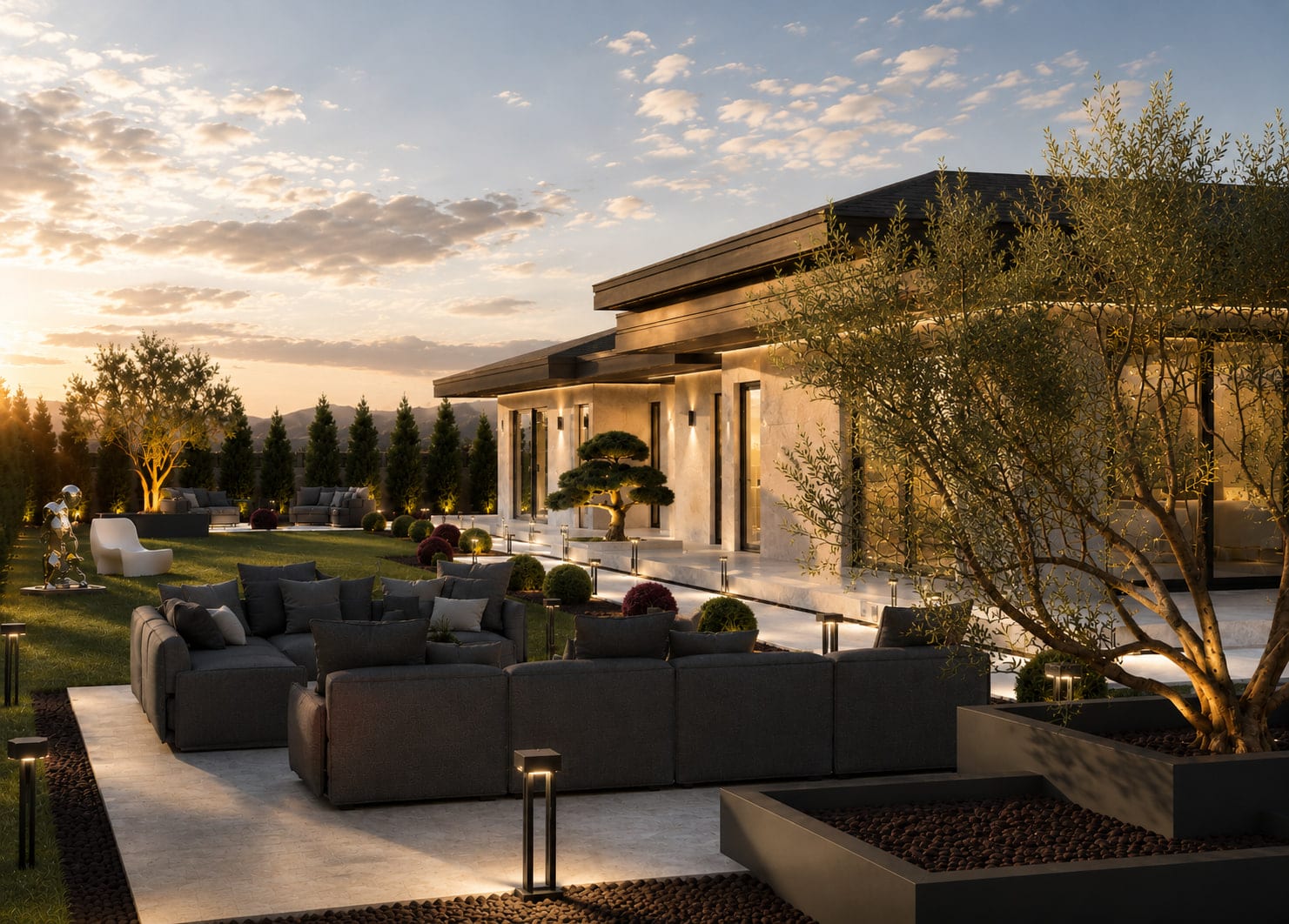
The entrance axis: travertine slabs direct without cutting the lawn, and the black pebble band sets a maintenance-free boundary between materials.
3. The pool is not a body of water — it is the spine of the garden
A pool is usually positioned "for swimming". Yet in a villa garden its real function is often not swimming but reflecting, cooling and organising the space. Its position therefore matters as much as how its edge is resolved.
At Opia the rectangular pool defines the garden's main axis; its still surface reflects the sky and the villa, visually enlarging the volume. Wave-form loungers set into the water turn the pool into a resting terrace, while the curved stainless steel waterfall adds a layer of sound — running water is the most natural mask for neighbour and traffic noise.
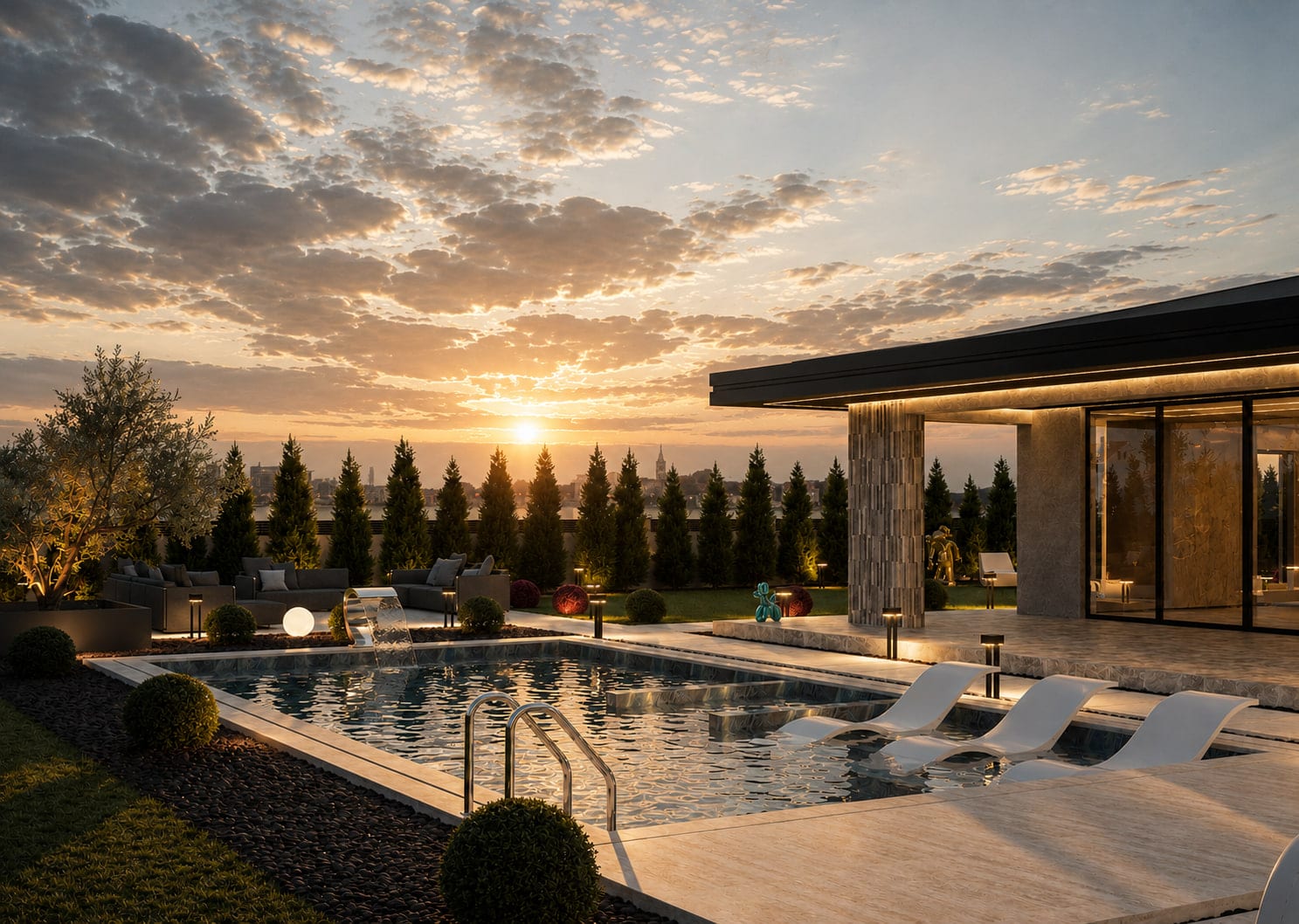
The pool is the spine of the garden: the still surface enlarges the space, and the curved waterfall adds both movement and sound.
4. A fire pit extends the garden into the evening and the season
In the Turkish climate the real constraint on a garden is not temperature but day length. If the garden empties when the sun sets, most of the investment has been squeezed into a few hours of the day. A heat source changes that equation directly.
At Opia a fire pit lounge was built at the far end of the pool on a curved marble platform. The ring of white organic seating around the flame bowl produces a hosting scenario that runs from sunset to midnight. The fire pit is also the garden's second focus: the pool gathers the day, the fire gathers the evening — so the garden works around two different centres across the day.
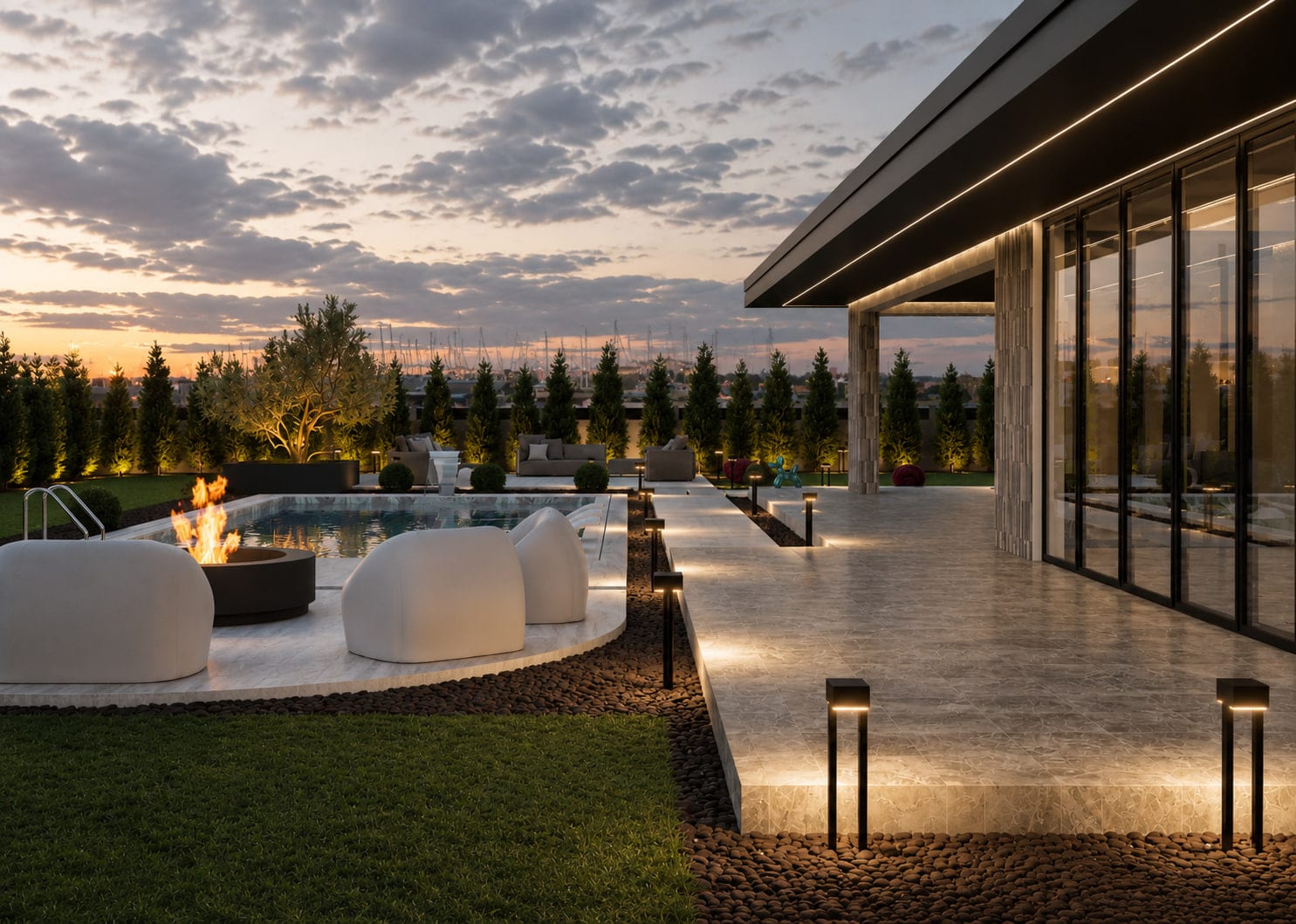
The fire pit is the garden's second focus: the pool gathers the day, the fire the evening.
5. Disciplined planting is what carries bold accents
The riskiest way to create character in a garden is to add decorative objects; the result is usually a scattered collection. What manages that risk is not the objects themselves but the discipline of the planting order behind them.
At Opia the planting was deliberately built in a plain, repeating language: an orderly row of cypress at the boundary, clipped box spheres in groups, olive trees in anthracite planters, and a cloud-pruned (niwaki) bonsai at the entrance. Set against that calm ground, the giant topiary animal figures, the turquoise balloon dog and the red Spun chairs work without tipping into ostentation. The rule is simple: the bolder the accent, the calmer the ground must be.
6. Landscape lighting is layered, not uniform
In most projects garden lighting amounts to a few floodlights scattered across the plot; the result is glaring, shadowless and flat. Yet at night a garden is a more controlled stage than by day — because you decide what will be seen.
At Opia the light was composed in four layers:
- Linear LED under the eaves: the horizontal line tying the building to the garden; it keeps the villa legible at night.
- Bollard fittings: the functional layer making walkways and level changes safe.
- Tree uplights: washing the texture of the olives and cypresses from below to give the garden depth.
- Light spheres and underwater lighting: the atmospheric layer; it puts the pool and seating areas on stage.
Keeping the layers on separate circuits means the same garden reads differently on an ordinary evening and on the night of a party.
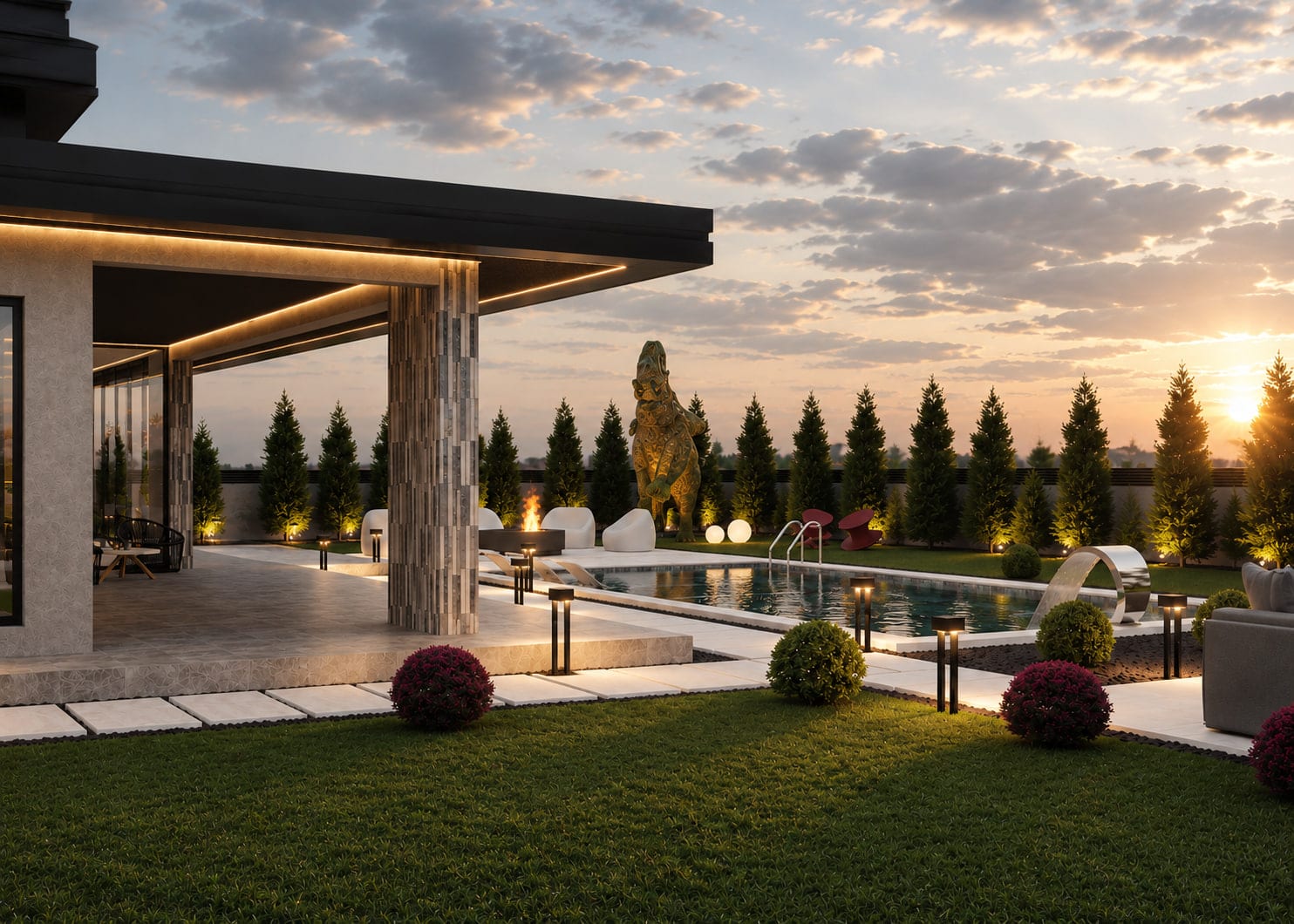
Layered lighting builds the garden's night face: path, texture, water and accent are each staged separately.
7. A garden is designed through scenarios
The success of a garden is measured not by its square metres but by how many times a week it is used. So a project should begin with a list of scenarios rather than a list of elements: where is morning coffee drunk, where do children play, how does a party of ten settle in, can you sit outside on a rainy evening?
Opia's landscape was composed as the answer to those questions: a shaded entrance terrace for the morning, the pool and loungers for the day, the fire pit ring for the evening, and the generous modular seating group in the front garden for larger groups. The garden is therefore never locked into a single mode of use.
We covered how continuity between interior and exterior is established in our article on luxury villa interior design, and how a villa moves from design to handover in the villa process from concept to turnkey.
Frequently Asked Questions
Where does villa garden design start?
Not with choosing plants or a pool, but with use scenarios and the circulation scheme. The route and its stops are set first; pool, seating and planting are then placed on that skeleton.
Where in the garden should the pool go?
What decides it is not only orientation but the relationship it forms with the house. Placed on an axis where it can be seen from the main living area and can reflect the building in its still surface, the pool produces a garden that feels both larger and gets used more.
What is the most common mistake in garden lighting?
Lighting everything at once with uniform, high-intensity fittings. Without layers a garden loses its depth at night, and sources aimed directly at the eye reduce comfort.
How much maintenance does landscaping create?
The maintenance load is set at the design stage. Topiary and shaped pruning demand regular attention; pebble borders, generous planting beds and an automatic irrigation system, on the other hand, cut the daily load considerably.
Can these decisions be applied in a small garden?
Yes. The scale changes, the logic does not: a route, one strong focus, a calm planting ground and layered lighting matter even more in small gardens.
Explore the Opia Residences landscape project
You can see the garden's entrance axis, front garden, pool terrace, fire pit lounge and night-time atmosphere together with a gallery of 19 images on the Opia Residences landscape design project page. For all of our residential work see Ankara villa design, and to discuss the scope of your own garden get in touch with us.
Project and text: Kaan Yalçınkaya, Kaya + Partners. Opia Residences landscape design; entrance axes, front garden, pool, fire pit and landscape lighting, 2026.